
Yes — electric cars do have a transmission. But it is nothing like the one in a petrol car. No gear changing. No clutch. No revving. Just one simple gear that handles everything quietly in the background. This guide explains how it works — and why it makes driving so much smoother.
Do Electric Cars Have Transmissions?
Yes — electric vehicles do have a transmission. But it is nothing like the one in a petrol car. No gear shifting. No clutch pedal. No revving through gears to find power. An EV uses a single-speed transmission — one fixed gear that handles everything from a standing start to motorway cruising.
Most drivers never think about it at all. That is the point. The EV transmission does its job silently and invisibly, every single time.
- 1Gear in a typical EV transmission
- 6–10 Gears in a typical petrol car gearbox
- Zero Gear changes needed while driving an EV
- ~90% Energy efficiency of an EV drivetrain
Why Do Vehicles Have Transmissions at All?
Every engine has a speed range where it works best. Too slow and it struggles. Too fast and it over-revs. The problem is that a car needs to travel at lots of different speeds — slow in traffic, fast on the motorway, and everything in between.
A transmission solves this. It sits between the engine and the wheels and adjusts the connection between them. So the engine can stay in its comfortable range no matter how fast or slow the car is going.
- Slow speed
- Crawling in traffic or pulling away
- Medium speed
- Town driving and side roads
- Fast speed
- Motorway cruising at 70 mph+
Without a transmission, a petrol engine simply could not do all of these. It would either stall when trying to move off from a stop or it would max out before the car got anywhere near motorway speed. It needs that middle layer to cope with the full range.
Think of it like a bicycle. You use a low gear to get going from a stop ,it takes less effort to turn the pedals. You switch to a high gear once you are moving to go faster without your legs spinning like mad. A car gearbox does exactly the same thing, it matches what the engine can do to what the road is asking for, at every speed.
How Does a Transmission Work in a Petrol Car?
In a conventional car, the engine produces power by burning fuel. But that power only arrives efficiently within a specific RPM range — usually somewhere between 2,000 and 5,000 revs per minute. Below or above that band, the engine is either struggling or spinning uselessly.
The gearbox solves this by offering multiple gear ratios. Each gear multiplies or reduces the relationship between engine speed and wheel speed:
First gear— lots of pulling force, very low speed. Perfect for moving off from a stop.
Third gear— balanced speed and power for town driving.
Sixth gear— low revs, high speed, efficient cruising on the motorway.
Whether you change gears manually or the car does it automatically, the principle is the same: keep the engine in its sweet spot by constantly adjusting the gear ratio as the car’s speed changes.
- Petrol engine
- Narrow power band
- Needs multiple gears to stay efficient across different speeds. Power builds gradually as revs climb. Gear changes required constantly.
- Electric motor
- Wide power range
- Delivers full power from the very first moment across a huge speed range. One gear is all it needs. No shifting, ever.
How Does a Transmission Work in an EV?
An electric motor is fundamentally different from a petrol engine. It does not have a narrow power band. It produces full torque from zero RPM — meaning maximum pulling force is available the instant it starts spinning, and stays available across a very wide speed range. Because of this, an EV does not need to keep switching between gear ratios.
One single gear ratio works perfectly from 0 mph all the way to top speed.
Here is how the power flows:
Battery → Converter → Electric Motor → Single-Speed Gear → Wheels
The single-speed gear reduces the motor’s high spinning speed down to a usable wheel speed. That is its only job. No clutch. No gear selector. No hesitation between ratios. Power flows directly, smoothly, and instantly every single time you press the pedal. Exception performance EVs: A small number of high-performance electric cars use a two-speed transmission. The second gear allows for better top-speed efficiency without sacrificing the instant low-speed acceleration. But this is rare, and most drivers will never encounter it.
How Many Gears Do Electric Cars Have?
Almost all electric cars have just one gear. That single gear handles everything. There is no first, second, third, or reverse gear in the traditional sense — the motor simply spins in the opposite direction for reversing. This is one of the most surprising things for people coming from petrol cars. You never change gear. You never feel the car hunting for the right ratio. You just press the pedal and go — smoothly and immediately, every single time.
| Vehicle type | Number of gears | Gear changes while driving |
| Manual petrol car | 5–7 | Constant — driver controlled |
| Automatic petrol car | 6–10 | Constant — computer controlled |
| Standard electric car | 1 | None — ever |
| Performance EV (rare) | 2 | Once — at high speed only |
EV Acceleration — How the Transmission Works and Why It Feels Unique
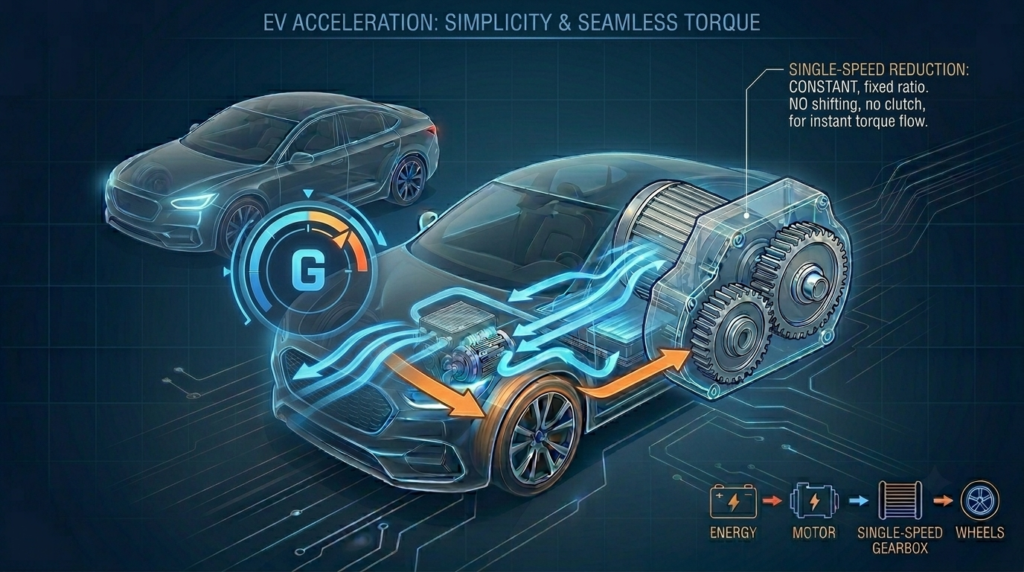
The single-speed EV transmission is one of the main reasons electric cars feel so different — and so satisfying — to drive. In a petrol car, acceleration is interrupted. Every gear change creates a tiny pause in power delivery. You feel the car surge, pause, surge again as it climbs through the gears. In an EV, there are no interruptions. Power builds in one smooth, unbroken surge from a complete stop all the way to full speed.
“In an electric car, there are no gears to change, no clutch to slip, no power to interrupt. Press the pedal and the car simply goes — all the way.”
This is why even ordinary family EVs can feel faster than performance petrol cars off the line. It is not just about raw power — it is about how that power is delivered. Instantly. Continuously. Without interruption. Why does this matter for everyday driving? Joining a motorway, overtaking, pulling out of a junction — all of these feel effortless in an EV because there is no gear change interrupting the acceleration at exactly the moment you need power most.
Do You Have to Maintain Electric Car Transmissions?
This is one of the most welcome surprises for new EV owners: the answer is almost no. A petrol car’s gearbox contains dozens of moving parts — gear sets, synchronisers, bearings, seals — all of which wear over time and eventually need attention. Automatic gearboxes also require regular transmission fluid changes. An EV’s single-speed gear unit is dramatically simpler. There are very few moving parts, no complex synchronisation systems, and in most cases the gear unit shares oil with the motor and runs for the lifetime of the car without needing a change.
✕ No transmission fluid changes in most EVs
✕ No clutch to replace
✕ No gear synchronisers to wear out
✓ Occasional gear oil check on some models
✓ Simple visual inspection at service time The result is a component that most EV owners will never spend money on during the life of their car. It is one of several reasons why the total cost of running an EV is significantly lower than a petrol equivalent over time.
EV vs Petrol Transmission — Side by Side
| Feature | Petrol car gearbox | EV single-speed gear |
| Number of gears | 6–10 | 1 |
| Gear changes while driving | Constant | None |
| Clutch required | Yes (manual) / complex auto | No |
| Power delivery | Interrupted between gear shifts | Smooth and continuous |
| Transmission fluid changes | Every 30,000–60,000 miles | Rarely or never |
| Number of moving parts | Dozens | Very few |
| Maintenance cost | Moderate to high | Very low |
| Typical lifespan | Needs servicing throughout | Often lasts lifetime of car |
Global Demand for EVs and EV Transmissions
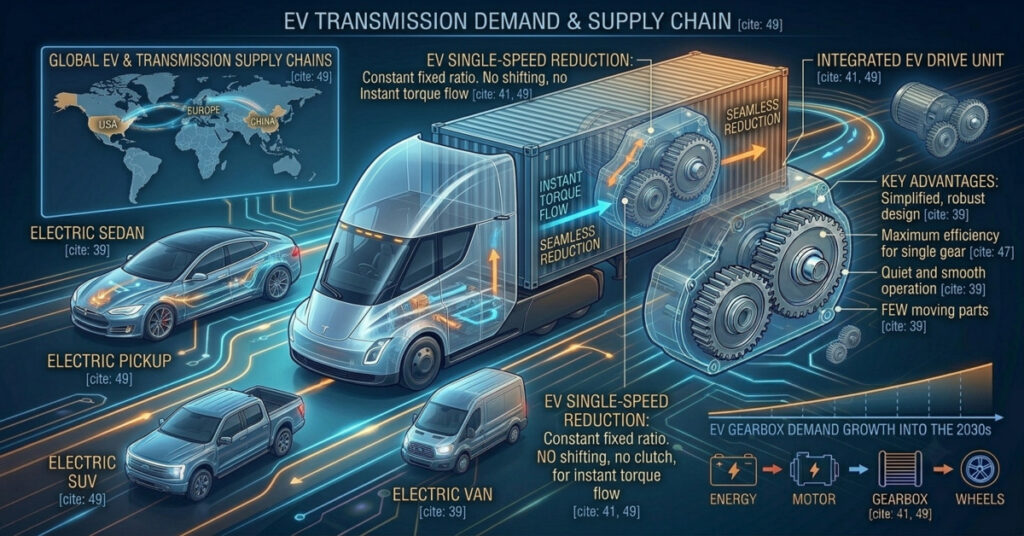
More people are buying electric cars every year. Governments are planning to ban new petrol cars, and car makers are switching to electric. This means the parts inside electric cars are needed more than ever — and that will keep growing into the 2030s.
The USA, China, and Europe are out in front. In America, people are buying electric trucks, SUVs, and family cars — not just Teslas. So what does this mean for gearbox makers? Petrol cars need a gearbox to change speed — it shifts up and down as you drive.
Electric cars don’t work that way. They use one simple, fixed gear that handles everything smoothly and quietly. For companies that make gearboxes, this is a big shift — but not a bad one. Instead of building complicated multi-gear systems, they now focus on making that one gear work as well as possible. It’s often built together with the motor in one neat unit.
A small side note: A few makers are testing two- or three-gear systems for electric trucks and sports cars, where extra speed control helps. But for most everyday cars, the single gear is still the way to go.
Transmissions Are Still Vital in Electric Vehicles
Just because an electric car has a simpler gearbox doesn’t mean it matters less. In fact, it matters just as much — maybe more. That single gear has a tough job. The electric motor spins incredibly fast — far faster than a petrol engine. The gear’s job is to take that speed and turn it into smooth, steady power at the wheels.
And it has to do this quietly, reliably, and for a very long time. Get it right, and the car feels great. Get it wrong, and it shows. Smaller, simpler — but just as essential The electric car’s gearbox is smaller and quieter than the ones in petrol cars. It needs less maintenance too. But it is just as important to how the car drives. It hasn’t disappeared — it has just evolved. Its job is no longer to manage lots of gears. Its job is to make driving feel effortless.
The Driving Feel
One gear. No gear changes. No noise. Just smooth, instant power every time you press the pedal. Whether you’re buying your first electric car or just want to understand how they work — this is one of the simplest examples of why electric cars feel so good to drive.
No waiting for the engine to rev up, no hunting for the right gear, no vibration through the pedals. You press the accelerator and the car responds immediately. That seamless, effortless acceleration is what makes driving an electric car feel so different — and so good.
FAQ: Do Electric Vehicles Have Transmissions
Q:What kind of transmission does an electric car have?
Most electric cars have a single-speed transmission — one fixed gear that delivers smooth, instant power with no gear changes needed.
Q: What is the biggest problem with electric cars?
The biggest concerns are charging time and driving range — charging takes longer than filling up with petrol, and charging points can still be hard to find in some areas.
Q: Do Tesla cars have a transmission?
Yes — Tesla cars use a single-speed transmission, just like most electric cars. There are no gears to change, which is why they feel so smooth to drive.
Q: Do electric cars need transmission fluid?
Some do and some don’t, depending on the model. Check your car’s manual — many sealed units never need fluid changes at all.
Q: Do electric cars have a gearbox?
Yes, but a much simpler one — just a single gear instead of five or six. It does the same basic job, just quietly and without any gear shifting.