
Electric cars explained simply — how the battery stores power, how the motor moves the car, and why millions of drivers are making the switch.
1. What Is An Electric Vehicle?
Electric cars are simpler, quieter, and more efficient than petrol vehicles. Here is a plain-English breakdown of exactly how they work no engineering degree required.
The simple definition
An electric vehicle (EV) is any vehicle driven by one or more electric motors not a petrol or diesel engine. Instead of burning fuel, it draws energy from a large rechargeable battery pack stored beneath the floor. That is the whole idea. No combustion. No fumes. Just electricity in, motion out.
A quick bit of history
Electric cars are not a new invention. The idea dates all the way back to the 1880s and electric cars were actually more popular than petrol cars in the United States during the early 1900s. Cheap oil arrived. Petrol engines became affordable for everyone.
And just like that, electric cars almost disappeared for about 100 years. Now they are back. Better batteries, smarter technology, and more charging points have made EVs practical for everyday life. This time, they are here to stay.
How It Works: Three Simple Steps. That is All.
1 Store it. Your EV charges up and saves electricity in its battery like a giant version of the battery in your phone.
2 Use it. Press the accelerator. Electricity flows from the battery to the motor. The motor spins.
3 Move. The spinning motor turns the wheels. The car moves quietly, instantly, smoothly.
The whole thing happens in a split second, every single time you pull away. You will not hear it. You will barely feel it start. But you will notice how fast it goes. Easy way to picture it: A petrol engine is like lighting a fire it takes time, it is messy, and it runs hot. An electric motor is like flicking a light switch instant, clean, silent.
What An EV Does Not Need?
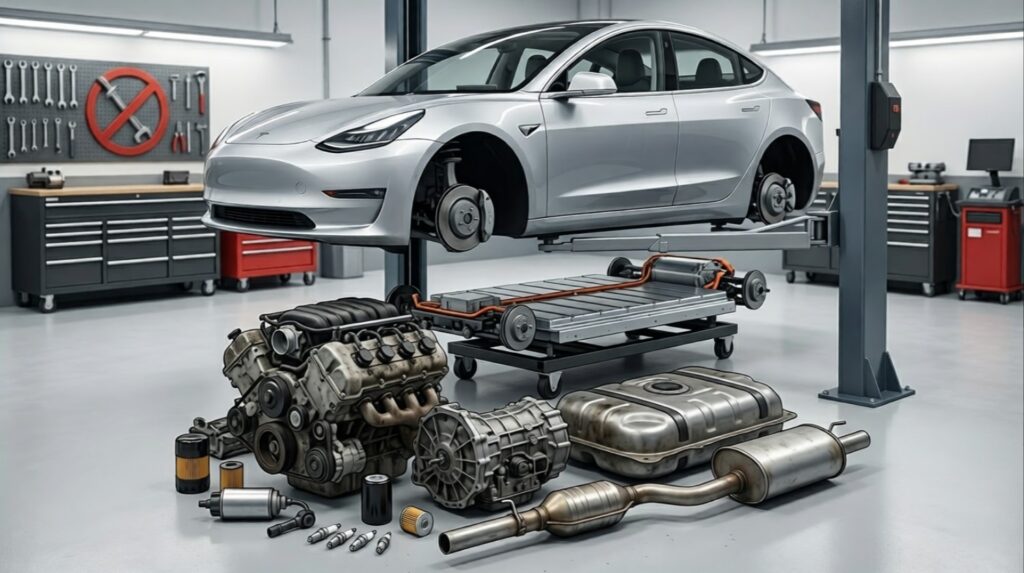
No engine. No fumes. No drama.
Most people are surprised by how much an electric car simply does not have.
There is no:
✕ Spark plugs or fuel injectors
✕ Gearbox with multiple speeds
✕ Exhaust pipe or engine fumes
✕ Engine oil to change
✕ Engine noise or shaking at idle.
Take all of that away and what do you get?
A car with far fewer parts to go wrong, far less to service, and a much quieter, smoother ride. And instead of waiting for power to build up like you do in a petrol car an electric motor gives you full power the instant you press the pedal.
Why does that feel so different?
In a petrol car, the engine has to build up speed before power kicks in. An electric motor is already at full strength from the very first moment it turns. That is why even a regular family EV can surprise you with how quickly it pulls away. Why this matters to you Millions of people have already made the switch. They are saving money on fuel. They are spending less on servicing.
And most of them say they would never go back to a petrol car. The more you understand how an EV works, the easier that decision becomes. The next sections cover the battery, the motor, how charging works, and what day-to-day life with an EV actually looks like.
Types of Electric Cars
Not all cars called “electric” work the same way. The term covers several distinct powertrains, each with different levels of electrification:
1. Battery Electric (BEV) 100% electric.
No combustion engine. Runs entirely on energy stored in a large battery pack. Examples: Tesla Model 3, Nissan Leaf, BMW i4.
2. Plug-in Hybrid (PHEV)
Combines a petrol engine with a rechargeable battery. Can drive short distances on electricity alone, then switches to the combustion engine. Examples: Toyota RAV4 Prime, Mitsubishi Outlander PHEV.
3. Hybrid (HEV)
Uses a petrol engine assisted by a small electric motor. Cannot be plugged in — the battery charges through regenerative braking only. Examples: Toyota Prius, Honda Insight.
4. Fuel Cell (FCEV)
Generates electricity onboard from hydrogen using a fuel cell. Water vapour is the only emission. Examples: Toyota Mirai, Hyundai Nexo.
There are several types of electric vehicles but this guide focuses on one: the fully electric car. These are cars that run on battery power alone. No petrol. No backup engine. Just a battery and a motor. They are the most popular type of EV right now and the one most people mean when they say “electric car.” Think of it as the purest, simplest version of an electric car. Charge it up. Drive. That is it. Everything in this guide applies to this type.
From The Plug To The Wheels — One Simple Journey
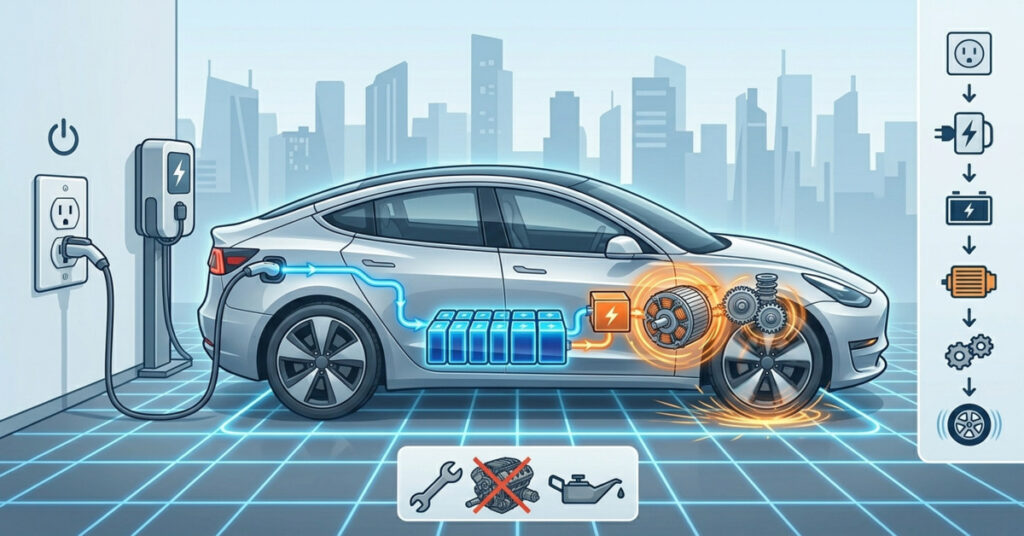
Every time you drive an electric car, electricity goes on a short trip through the car before it reaches the wheels.
Here is exactly what happens, step by step in plain English.
Wall socket → Charger → Battery → Converter → Motor → Gear → Wheels
1: Charging Fills Up The Battery
When you plug your EV in at home or at a charging point, electricity flows into a large battery stored under the car’s floor. Think of it like charging a phone just much bigger. The battery is made up of thousands of small cells working together. A small computer inside the car watches over every one of them making sure they charge evenly, stay cool, and do not get damaged. It also shows you an accurate range estimate on the screen.
How big is the battery? Small city EVs hold enough energy to power a home for a day or two. Long-range EVs hold more than twice that. The bigger the battery, the further you can go.
2: You Press The Pedal
When you press the accelerator, the car does not open a valve or squirt fuel anywhere. It simply sends a quick electronic message like pressing a button telling the motor how much power you want. The response is almost instant. There is no warming up, no waiting, no delay. That is why electric cars feel so quick off the mark.
3: The Converter Prepares The Power
The battery stores electricity in one form. The motor needs it in a different form. A small but clever device inside the car called a converter changes it across in a fraction of a second. It also controls exactly how much power reaches the motor, which is how the car manages its speed and smoothness so precisely. Simple way to picture it: It is like a translator. The battery speaks one language. The motor speaks another. The converter translates between them instantly and continuously.
4: The Motor Turns The Wheels
The motor takes that electricity and spins. That spinning motion travels through a single small gear much simpler than the multi-gear gearbox in a petrol car and reaches the wheels. The big difference from a petrol engine? Full power arrives immediately.
There is no revving required. No waiting to hit a sweet spot. The motor pulls hard from the very first moment which is why even ordinary electric family cars feel surprisingly fast. Why no gearbox? Petrol engines need multiple gears to stay in their power range.
An electric motor works well across all speeds so one simple gear is all it needs. Fewer parts. Less to go wrong.
5: Braking Puts Energy Back In
Here is one of the cleverest things about electric cars. When you slow down or take your foot off the pedal, the motor does not just stop it runs in reverse and acts like a charger.
The energy from the moving car gets turned back into electricity and sent back to the battery. So every time you brake, you are topping up the battery slightly.
In town driving, this can recover up to a quarter of the energy used meaning you can go further on the same charge.
Think of it like this: In a petrol car, braking wastes energy as heat. In an EV, braking saves it. The car recycles its own momentum.
85–90% of electricity actually reaches the wheels in an EV <20% of petrol energy reaches the wheels the rest is wasted as heat.
A petrol engine wastes most of its fuel as heat before it ever moves the car. An electric motor sends nearly all of its energy straight to the wheels cleanly and quietly.
Key Components Explained
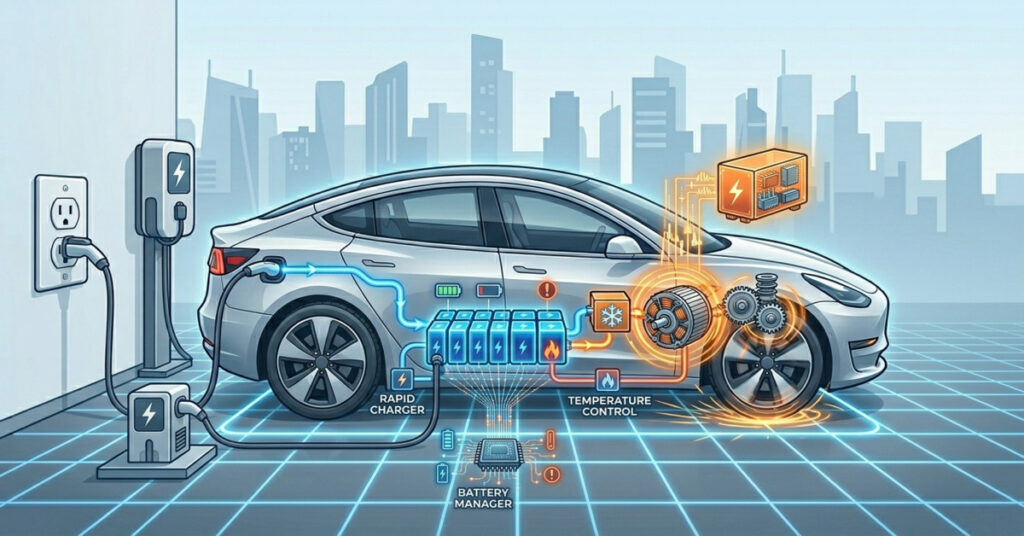
The key parts explained simply
Battery Pack
The fuel tank — but for electricity.
This is where the car stores all its energy. It sits flat under the floor, which keeps the car stable and gives you more cabin space. The bigger the battery, the further you can drive before charging. Think of it as a giant version of the battery in your phone just thousands of times bigger.
Electric Motor
Turns electricity into movement.
The motor takes power from the battery and spins. That spinning drives the wheels. It delivers full power the instant you press the pedal no warm-up, no delay, no noise. Unlike a petrol engine, the motor has almost no parts that wear out so it lasts a very long time.
Converter Translates
Power so the motor can use it.
The battery and the motor speak different “electrical languages.” The converter switches the power from one form to the other in a split second and also controls exactly how fast and smoothly the motor runs. It is one of the smartest parts in the car, even though most drivers never think about it.
Onboard Charger
Brings electricity in from the wall.
When you plug in at home or at a slow charger, this part converts the electricity from the socket into a form the battery can store. Rapid public chargers skip this step entirely and charge the battery directly which is why they are so much faster. Slow charger = goes through the onboard charger. Rapid charger = goes straight to the battery.
Battery Manager
The brain that looks after the battery.
A small computer watches over every cell in the battery, around the clock. It makes sure no cell gets too full or too empty, stops the battery from overheating, and tells the dashboard how much range you have left. Without this, the battery could be damaged just from normal use. It is the hidden guardian of your EV.
Temperature Control
Keeps everything at the right temperature.
Batteries do not like being too hot or too cold. This system heats or cools the battery and motor automatically to keep them working well whether it is a freezing winter morning or a hot summer afternoon. It also helps warm or cool the cabin. This is why EVs often pre-heat the battery on cold days before you even set off.
How EV Charging Works
Charging an electric car is simply the process of pushing electrical energy back into the battery. The speed at which that happens depends on the power level of the charger and the maximum charge rate the car can accept.
| Level | Power | Connector type | Typical charge time (60 kWh) | Best for |
| Level 1 (slow) | 1.4–2.4 kW | Standard household socket | 25–40 hours | Overnight top-up, low daily mileage |
| Level 2 (fast AC) | 7–22 kW | Type 2 / J1772 | 3–9 hours | Home wallbox, workplace, retail |
| DC Fast Charge | 50–350 kW | CCS, CHAdeMO, NACS | 20–45 minutes (to 80%) | Long-distance travel, en-route stops |
Why Electric Cars Cost So Much Less To Run
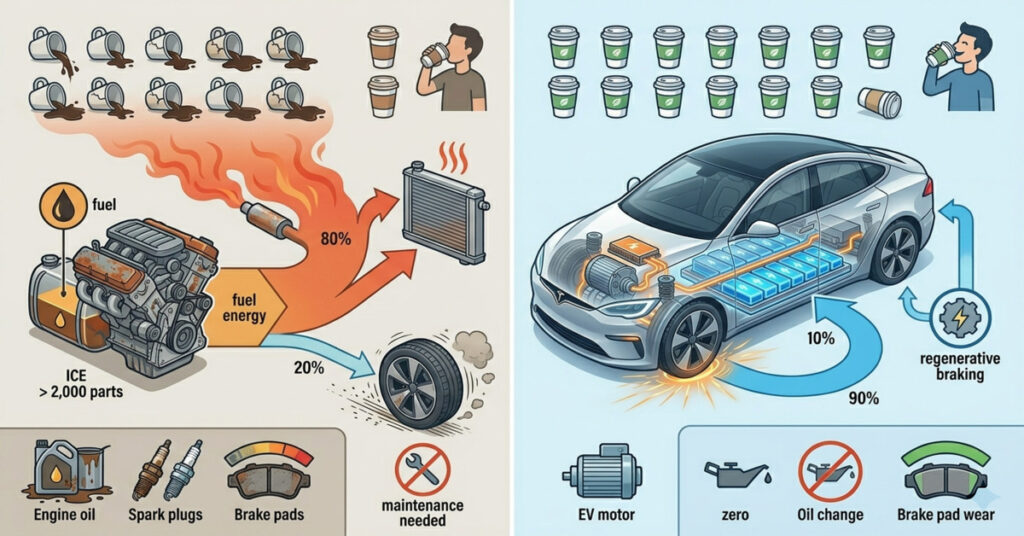
A petrol car and an electric car both need energy to move. But what happens to that energy inside each car is very different and that difference is why EVs are so much cheaper to run.
Petrol car ~20% reaches the wheels
When you burn petrol, most of the energy disappears as heat out of the exhaust, through the radiator, lost to friction. Only a small slice actually moves the car.
Electric car ~90% reaches the wheels
An electric motor sends almost all of its energy straight to the wheels. Very little is wasted. What you put in is almost exactly what you get out.
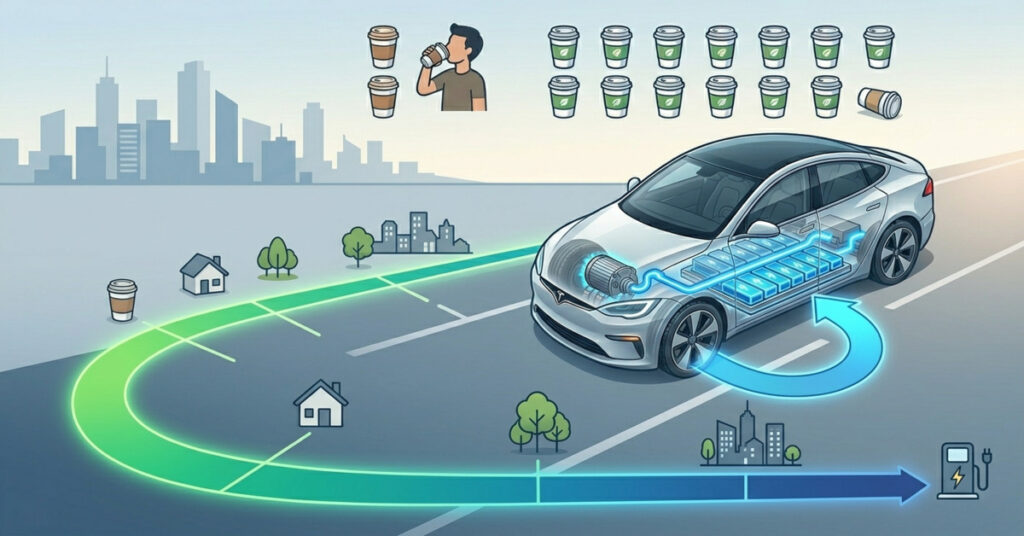
Petrol car — energy that actually moves the car~20%
Electric car — energy that actually moves the car~90%
Think of it this way. Imagine paying for ten cups of coffee but only being allowed to drink two of them. The rest just get poured away. That is roughly what happens every time you fill up a petrol car. An EV lets you drink nine out of ten.
What about braking? Every time you slow down in an EV, some of that energy goes back into the battery instead of vanishing as heat. So the car is actually topping itself up as you drive especially useful in town.
All of this adds up to real savings at the end of the month. Charging an electric car typically costs the same as paying $1 to $2 per gallon of petrol in energy terms depending on your local electricity price. Most EV drivers cut their fuel bill by more than half.
By the Numbers — EVs vs Petrol Cars at a Glance
Less than 30 moving parts inside a typical EV motor and drivetrain
2,000+ moving parts inside a typical petrol engine
Zero oil changes needed — ever
Around 70% fewer brake pad replacements compared to a petrol car
Fewer parts means fewer things to go wrong. It also means far less time and money spent at the garage. Most EV owners say that lower servicing costs are one of the biggest surprises after switching.
What Owning an EV is Really Like — Day To Day
How far Can You Go On a Single Charge?
Most modern electric cars can travel 250 to 400 miles on a full charge ,enough for the vast majority of everyday journeys without stopping to recharge. Your actual range will vary depending on a few things:
Mild weather, steady speed
Full range Motorway driving at high speedAbout 75%
Very cold weather with heating onAbout 55%
Cold weather has the biggest effect.Batteries do not work as well in freezing temperatures, and running the heater uses extra power. The simple fix: plug in overnight and let the car warm up while it is still connected to power ,so it uses grid electricity to heat up, not battery energy.
Handy tip: Set your car to warm up before you leave home , while it is still plugged in. You will start every journey with a full, warm battery and a cosy cabin.
Why EVs Feel So Fast
Press the pedal in an electric car and the power arrives immediately ,no hesitation, no gear changes, no build-up. It is smooth and instant every single time. This is because an electric motor gives you its full power from the very first moment it turns. A petrol engine has to rev up and find its power range first.
High-performance EVs use this to produce jaw-dropping acceleration , but even ordinary family electric cars feel noticeably quicker off the line than similar petrol cars. It is one of the first things new EV owners notice and love.
In simple terms: Petrol power builds up gradually, like turning up a dial. Electric power is instant, like flicking a switch. That is what makes EVs feel so responsive.
🔧 Servicing :far simpler than a petrol car This is one of the biggest hidden benefits of going electric. Because there is no combustion engine, a huge list of things you used to pay for simply disappear.
PETROL CAR you pay for:
✕ Engine oil changes
✕ Spark plugs
✕ Timing belt replacement
✕ Fuel filter
✕ Exhaust repairs
✕ Gearbox servicing
EV you only need:
✓Tyre checks
✓ Cabin air filter
✓ Windscreen washer fluid
✓ Occasional brake check
Brakes also last much longer in an EV. Because the car slows itself down using the motor most of the time, the actual brake pads are used far less and wear out much more slowly. 8–15 yrs Typical lifespan of an EV battery pack 8 yr Battery warranty most manufacturers offer ~70% Fewer brake pad replacements vs petrol.
Better For the Environment — Here is The Real Picture
An electric car produces no fumes from the exhaust — ever. That alone makes a big difference in towns and cities.
The bigger question people ask is: what about the electricity used to charge it? Fair question. The answer depends on where your electricity comes from.
Grid mostly from fossil fuels Even then, an EV still produces 40–70% fewer carbon emissions over its lifetime than a petrol car. Power stations are simply more efficient at burning fuel than millions of individual car engines.
Grid mostly from renewables The difference becomes enormous. An EV charged on wind or solar power produces a tiny fraction of the emissions of a petrol car , close to zero over its lifetime.
And here is the best part: as countries add more wind, solar, and other clean energy to the grid, your EV automatically gets cleaner over time ,without you doing anything. The same car you buy today will have a smaller environmental footprint in five years than it does now.
Wherever you live, an EV is already better for the environment than a petrol car. And it keeps getting better every year, as the electricity grid gets cleaner.
The Bottom Line
Electric cars are simpler, cheaper to run, and better for the environment than petrol cars. Once you understand how they work — the battery stores energy, the motor moves the car, and braking puts energy back — there is very little to be uncertain about.
Ranges are longer, charging is faster, and costs keep falling. Millions of drivers have already made the switch, and most say they would never go back.
FAQs About How Electric Cars Work
Q: Why does an electric car not need gears?
An electric motor delivers full power at any speed, so one simple gear is all it needs. No gear changes, ever — just smooth, instant power from start to top speed.
Q: What happens when you brake in an electric car?
The motor runs in reverse and turns the car’s movement back into electricity, which goes straight to the battery. So every time you brake, you are also topping up your charge.
Q: How does the EV battery work?
It stores electricity — just like a phone battery, but much bigger. Charge it up, use it, and charge again — it is built to last well over a decade.
Q: Are electric cars cheaper to run?
Yes — electricity costs less than petrol per mile, and servicing is far cheaper with no oil changes and fewer repairs. The more you drive, the more you save.
Q: How long does charging take?
A home charger takes 8–10 hours overnight for a full charge. A rapid public charger gets you to 80% in just 20–35 minutes.
Q: What type of motor does an EV use?
Most EVs use a motor powered by the same type of electricity as your home sockets. A small converter inside the car prepares the power before it reaches the motor.
Q: Do electric cars need oil changes?
No — never. There is no engine oil in an EV, so day-to-day upkeep is just tyres, washer fluid, and an occasional air filter swap.