
Yes, most electric vehicles have radiators.
But they are not used in the same way as gasoline cars.Instead of cooling an engine, EV radiators help manage heat from the battery, electric motor, inverter, and other electronic parts.
These parts create heat when the vehicle is driving, stopping, or charging. To control this heat, EVs use a Thermal Management System.
Most modern electric vehicles use a Liquid Cooling System with a Heat Exchanger and Coolant Loop to move heat away from important components.
This keeps the High-Voltage Battery, motor, and electronics safe and working efficiently.
Key Takeaways
- Electric vehicles use radiators or heat exchangers for cooling
- EV radiators cool batteries, motors, and electronics
- A Battery Thermal Management System protects battery health
- A Liquid Cooling System is the most common modern method
- Electric Motor Cooling prevents overheating during driving
- Power Electronics Cooling protects electrical components
- The High-Voltage Battery needs strict temperature control
- A Thermal Management System improves performance and range
Why Electric Vehicles Have Radiators
Electric cars do not burn fuel like gasoline cars.
But they still produce heat.
This heat comes from:
- Battery pack
- Electric motor
- Power electronics
- Charging process
Even though there is no engine, electricity still creates heat when it moves through components.
If this heat is not controlled, it can cause:
- Slower charging
- Reduced driving range
- Lower performance
- Faster battery damage
That is why cooling systems are very important in EVs.
Which EV Parts Create Heat?
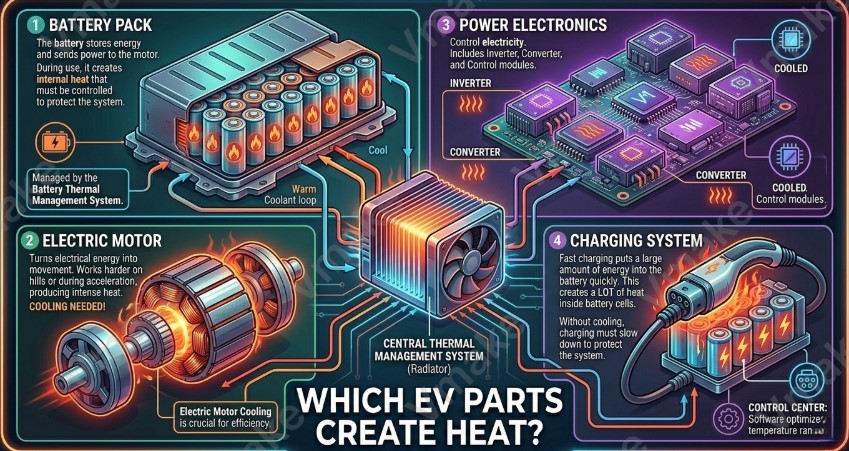
Battery Pack
The battery is the most important part of an electric car.
It stores energy and sends power to the motor.
But during use, it creates heat. That heat must be controlled to protect the battery.
This is managed by the Battery Thermal Management System.
Electric Motor
The motor turns electrical energy into movement.
When the car accelerates or climbs hills, the motor works harder and produces heat.
This is why Electric Motor Cooling is needed.
Power Electronics
Power electronics control electricity inside the vehicle.
They include parts like:
Inverter
Converter
Control modules
These parts also produce heat and require Power Electronics Cooling.
Charging System
Fast charging sends a large amount of energy into the battery quickly.
This creates heat inside the battery cells.
Without cooling, charging would need to slow down to protect the system.
What Does a Radiator Do in an Electric Car?
An EV radiator removes heat from a liquid called coolant.
It does not directly touch the battery or motor.
Instead, it cools the liquid that carries heat away.
How It Works Step by Step
- Coolant absorbs heat from EV parts
- Hot coolant flows through a Coolant Loop
- It reaches a Heat Exchanger (radiator)
- Air passing through removes heat
- Cool liquid goes back into the system
This cycle continues while the car is running or charging.
How EV Cooling Systems Work
Electric vehicles use advanced cooling systems that combine liquid flow, airflow, and smart software.
Liquid Cooling System
A Liquid Cooling System is used in most modern EVs.
It moves coolant around:
- Battery pack
- Motor
- Power electronics
Benefits
- Better heat control
- Faster charging support
- Longer battery life
- Stable performance
- Safer operation
Liquid cooling is now the industry standard.
Air Cooling Systems
Air cooling uses fans instead of liquid.
It is simpler but less powerful.
Limitations
- Less efficient cooling
- Poor performance in hot weather
- Not ideal for fast charging
That is why most new EVs do not rely on air cooling.
Thermal Management System
The Thermal Management System controls all cooling operations.
It acts like the brain of the system.
It uses sensors to:
- Measure temperature
- Control coolant flow
- Adjust cooling speed
- Protect battery and motor
This system ensures everything stays within a safe temperature range.
Battery Thermal Management System
The Battery Thermal Management System is one of the most important systems in an EV.
It keeps the battery safe in all conditions.
It does three main jobs:
- Cooling the battery when hot
- Heating the battery when cold
- Balancing temperature across cells
This helps improve battery life and performance.
Why Battery Temperature Is So Important
If the battery is too hot:
- Battery degrades faster
- Performance drops
- Range decreases
If the battery is too cold:
- Charging slows down
- Power output reduces
- Efficiency drops
That is why EVs must control temperature carefully using a High-Voltage Battery system.
How Fast Charging Creates Heat
Fast charging pushes large amounts of electricity into the battery quickly.
This creates heat because:
- Energy moves fast
- Battery cells resist electricity
- Chemical reactions increase
To manage this, EVs activate cooling systems during charging.
Without cooling, fast charging would not be safe.
Air-Cooled vs Liquid-Cooled Batteries
Air Cooling
- Uses fans and airflow
- Simple design
- Lower cost
- Less efficient
Liquid Cooling System
- Uses coolant fluid
- Highly efficient
- Better heat control
- Supports fast charging
- Used in most modern EVs
Liquid cooling is now the standard in modern electric cars.
Do Tesla Cars Have Radiators?
Yes.
Tesla vehicles use radiators and liquid cooling systems.
They help manage heat in:
- Battery packs
- Electric motors
- Power electronics
Tesla’s system is controlled by a smart Thermal Management System that adjusts cooling based on driving conditions.
EV Radiators vs Gasoline Car Radiators
| Feature | Electric Cars | Gasoline Cars |
| What they cool | Battery & electronics | Engine |
| Heat source | Electricity | Fuel combustion |
| Cooling system | Thermal system | Engine cooling system |
| Cooling design | Multiple loops | Single loop |
Unlike internal combustion engines, EVs do not have engine heat, but they still need strong cooling for electronics.
Why EV Cooling Systems Matter
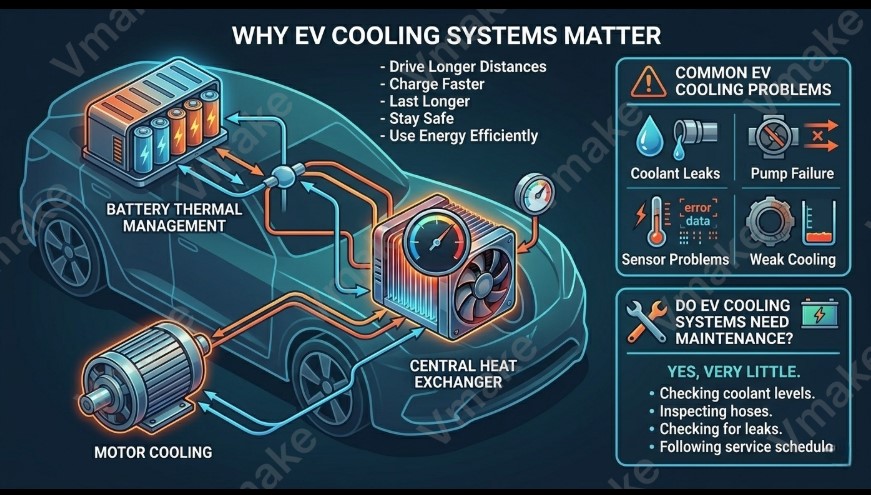
A strong Thermal Management System helps EVs:
- Drive longer distances
- Charge faster
- Last longer
- Stay safe
- Use energy efficiently
Without it, EV performance would drop quickly.
Common EV Cooling Problems
Even modern systems can have issues.
Coolant Leaks
Reduce cooling efficiency.
Pump Failure
Stops coolant from moving through the Coolant Loop.
Sensor Problems
Send wrong temperature readings.
Weak Cooling
Happens when parts wear out over time.
Do EV Cooling Systems Need Maintenance?
Yes, but very little compared to gas cars.
Basic maintenance includes:
- Checking coolant levels
- Inspecting hoses
- Checking for leaks
- Following service schedules
Most EV cooling systems last for years without major repairs.
How Heat Exchanger and Coolant Loop Work Together
The Heat Exchanger and Coolant Loop work as a team.
- The coolant loop moves fluid around the car
- The heat exchanger removes heat from that fluid
Together, they keep temperatures stable.
How Heat Pumps Improve EV Efficiency
Heat pumps help EVs use energy better.
They:
- Improve heating in cold weather
- Reduce energy waste
- Support battery temperature control
- Increase driving range
This makes EVs more efficient in all seasons.
Future of EV Cooling Technology
EV cooling systems are improving fast.
Future systems will include:
- Smarter Thermal Management Systems
- Better Liquid Cooling Systems
- Advanced Electric Motor Cooling
- Improved Power Electronics Cooling
- AI-based temperature control
These upgrades will improve charging speed, range, and battery life.
Frequently Asked Questions on Do Electric Vehicles Have Radiators?
Q: Do electric cars have radiators like gasoline cars?
Yes, but they cool batteries and electronics instead of engines.
Q: Why do EV batteries need cooling?
To prevent overheating and extend battery life.
Q: Can electric cars overheat?
Yes, but cooling systems prevent it in normal use.
Q: Do all EVs use liquid cooling?
Most modern EVs use a Liquid Cooling System.
Q: Does cooling affect EV performance?
Yes, it improves range and charging speed.
Q: Do electric motors need cooling?
Yes, Electric Motor Cooling prevents overheating.
Q: What happens if EV cooling fails?
The car reduces power or charging speed to protect itself.
Final Thoughts: Do Electric Vehicles Have Radiators?
Yes, electric vehicles have radiators. But they are used in a very different way than gasoline cars. EV radiators help manage heat from the battery, motor, and electronics. With systems like the Battery Thermal Management System, Liquid Cooling System, Thermal Management System, Coolant Loop, Heat Exchanger, Electric Motor Cooling, Power Electronics Cooling, and the High-Voltage Battery, electric cars stay safe, efficient, and reliable. As EV technology improves, cooling systems will become smarter and even more important for performance and fast charging.